
By Leslie Alvarez, CMCA, AMS, LSM, PCAM | Founder & CEO, Community ACE | communityace.com
Whether you are newly elected to your HOA board or have been serving for years, understanding your legal responsibilities is one of the most important things you can do — for your community and for yourself. Florida law imposes real obligations on HOA board members, and the consequences of not understanding those obligations can be significant.
This guide covers what Florida law requires of HOA board members, what fiduciary duty actually means in practice, and what every board should be doing to fulfill its responsibilities.
Under Florida Statute 720.306, only members of the homeowners association may serve on the board of directors. This generally means you must own a lot or home in the community. Tenants, non-owner family members, and renters cannot serve on the board.
Board members must be at least 18 years of age. Under HB 1203 (2024), individuals convicted of a felony in Florida or any other jurisdiction are ineligible to serve unless their civil rights have been restored for at least five years prior to the election. Board members who are more than 90 days delinquent in the payment of assessments may be removed from the board.
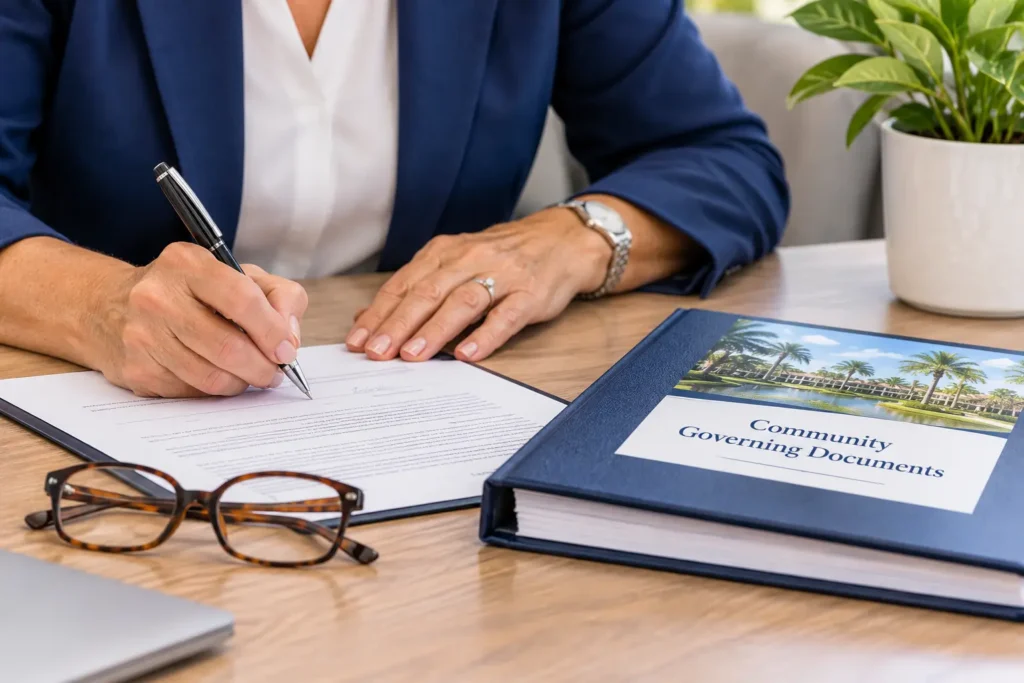
Every Florida HOA board member owes a fiduciary duty to the association and its members. This is not a vague concept — it is a legal standard with real consequences. Fiduciary duty encompasses three core obligations:
Board members must act with the level of care that a reasonably prudent person would exercise in similar circumstances. This means making informed decisions — not acting on incomplete information or without consulting appropriate professionals (attorneys, engineers, CPAs) when the situation warrants it.
Board members must act in the best interest of the association, not in their own personal interest. Conflicts of interest must be disclosed and managed appropriately. A board member who has a financial interest in a vendor contract cannot participate in the vote to approve that contract.
Board members must act within the authority granted to them by the governing documents and applicable Florida law. Actions taken outside that authority — even well-intentioned ones — can expose the board and the association to liability.
Florida law requires HOA boards to hold meetings that are properly noticed and open to owners. Under HB 1203 (2024), meeting agendas must be posted at least seven days in advance. Board meetings cannot be held via purely informal means. Minutes must be maintained and made available to owners.
Florida Statute 720.303 gives owners the right to inspect and copy association records. The board is responsible for maintaining accurate, complete records and responding to owner record requests within the timeframes required by law. Failure to provide records can result in fines and legal action.

The board is responsible for preparing an annual operating budget that accurately reflects the association’s anticipated income and expenses. The budget must be adopted in a properly noticed meeting and distributed to owners. Florida law also requires that certain reserve funds be maintained, and in some cases fully funded — particularly for condominium associations subject to SIRS requirements.
The board has both the authority and the obligation to enforce the community’s declaration, bylaws, and rules. Selective enforcement — applying rules to some owners but not others — creates legal liability. Enforcement must be fair, consistent, and documented.

The board is responsible for the maintenance of common areas and association property. Deferred maintenance that results in injury or property damage can expose the association to liability. Florida communities should have preventive maintenance programs in place and document maintenance activities.
Understanding the limits of board authority is as important as understanding its scope:
Florida courts apply the business judgment rule to HOA board decisions. Under this standard, a board member will not be personally liable for a board decision if: the decision was made in good faith, the member was reasonably informed, and the member rationally believed the decision was in the best interests of the association.
This rule provides important protection for board members who act thoughtfully and in good faith — but it does not protect board members who act with conflicts of interest, without information, or in bad faith.

Under Florida Statute 720.3033, newly elected or appointed HOA board members must, within 90 days of election or appointment, certify in writing that they have read the association’s governing documents and will uphold them, and complete an approved 4-hour Board Certification course. The certification is valid for 4 years, provided the board member serves continuously.
Returning HOA board members must complete 4-hours’ worth of continuing education courses for HOA’s under 2,500 units and 8-hours’ worth of continuing education courses.
This is not a suggestion — it is a legal requirement. Boards should track this obligation for every new member and maintain documentation of compliance.
Florida HOA boards are composed of volunteer homeowners who are not expected to be attorneys, CPAs, or engineers. The obligation is not to personally know everything — it is to get appropriate professional guidance when the situation requires it. Boards should maintain working relationships with:
Ready to take the next step? Community ACE helps HOA and condo boards across Florida operate more efficiently, stay compliant, and lead with confidence. Schedule a free 20-minute consultation with Leslie Alvarez, PCAM at communityace.com.




Privacy Policy | Terms of Use | Powered by Cajabra